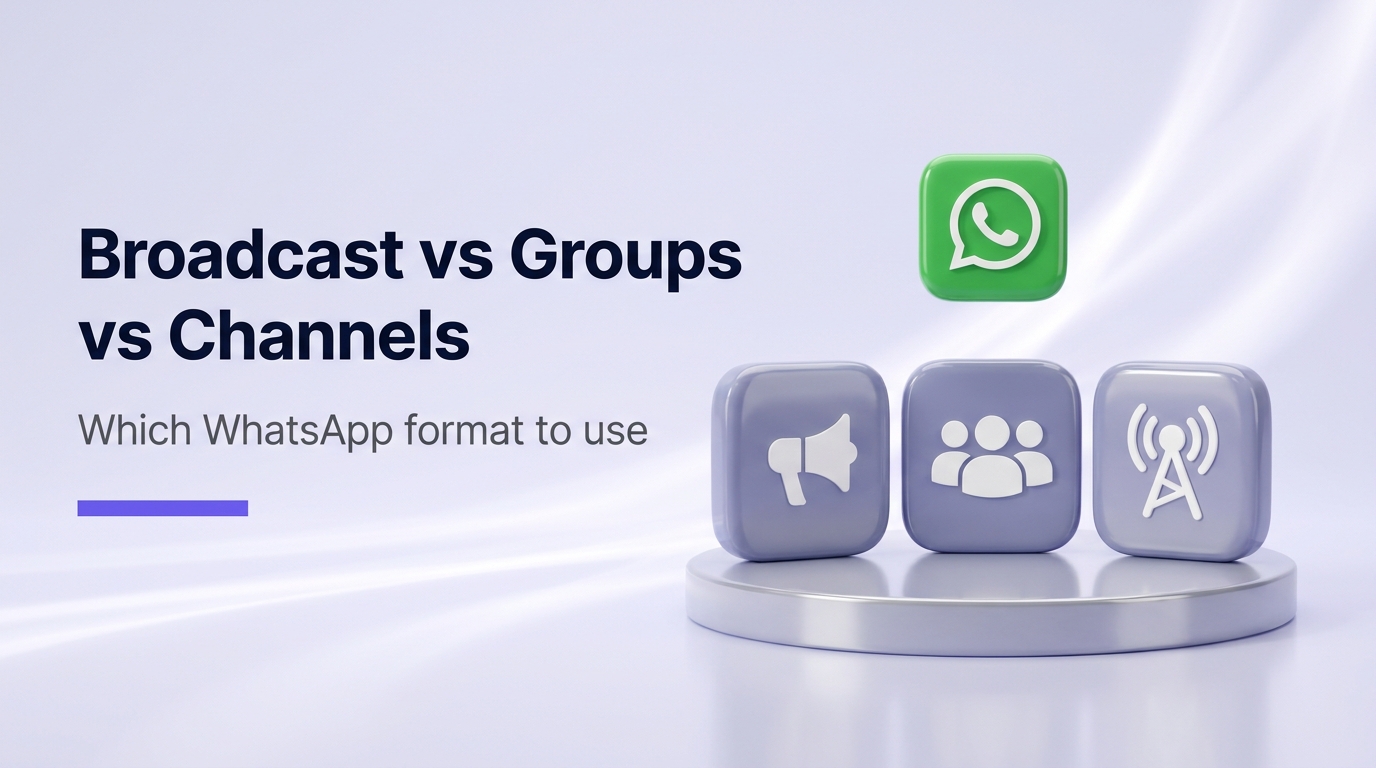
What is the difference between WhatsApp broadcast, groups and channels?
A broadcast sends one message privately to many contacts, and replies come to you individually. A group lets every member see and message each other. A channel is a public, one-way feed that followers subscribe to without sharing their number. Broadcasts sell, groups build community, channels announce.
Two mechanics decide most of this choice. A broadcast list caps at 256 contacts, and it only reaches people who have saved your number — which is the constraint most businesses discover too late. Channels have no such cap but are strictly one-way. Both limits are set by WhatsApp and have moved before, so confirm the current numbers in WhatsApp's own help documentation before you build a plan around them.
Why does choosing the wrong one cost you customers?
Because each format carries a different social contract, and breaking it triggers a different failure.
- Use a group for promotions and members mute or exit — often after complaining in the group itself, publicly.
- Use a broadcast too often and people block you, permanently removing them from every future message.
- Use a channel expecting conversation and you get silence, because there is no reply mechanism.
The format is not a delivery detail. It sets the expectation.
What is a WhatsApp broadcast list, and when should you use it?
A broadcast list sends the same message to multiple contacts individually. Each recipient sees it as a normal one-to-one message and has no idea who else received it. Replies come back to you privately.
The critical constraint: recipients only receive your broadcast if they have your number saved in their contacts. This is the rule most businesses discover after their first campaign underperforms.
Best for:
- Offers and sale announcements
- New stock or restock alerts
- Appointment and payment reminders
- Personalised re-engagement
Frequency discipline: two to four promotional broadcasts per month is the ceiling for most businesses. Transactional messages — order updates, receipts, reminders — have no such ceiling because customers want them.
What is a WhatsApp group, and when should you use it?
A group is a shared conversation. Every member sees every message and can message everyone else.
That is a feature for communities and a liability for retail. Members see each other's numbers, notifications multiply, and one dissatisfied customer can voice a complaint to your entire list at once.
Genuinely good uses:
- Course cohorts and training batches
- Clinic or gym programme groups
- Residential society or local trade groups
- Reseller and distributor coordination
- Small VIP customer circles where interaction is the point
Poor uses:
- General promotional lists
- Anyone who did not explicitly agree to join
- Groups larger than the conversation can sustain
Rule: if you would be uncomfortable with members talking to each other, do not use a group.
What is a WhatsApp channel, and when should you use it?
A channel is a one-way broadcast feed. People follow it, receive your updates, and cannot reply. Their phone numbers stay hidden from you and from other followers, and yours stays hidden from them.
Strengths:
- No number exchange required, so the barrier to follow is very low
- Discoverable in WhatsApp's directory
- Zero risk of the group-chaos problem
- Followers do not need your number saved
Weaknesses:
- No conversation, so no direct path to a sale
- No visibility into who is following
- Weak for conversion compared with a broadcast
Best for: announcements, content updates, brand presence, and building an audience you later convert through a different channel.
How do the three compare directly?
| Broadcast | Group | Channel | |
|---|---|---|---|
| Direction | One-to-many, private | Many-to-many | One-to-many, public |
| Members see each other | No | Yes | No |
| You see the audience | Yes, by contact | Yes | Follower count only |
| Recipients need your number saved | Yes | No | No |
| Replies | Private, to you | Public, to all | None |
| Best for | Selling | Community | Announcing |
| Main risk | Blocks | Chaos and exits | Low conversion |
| Discoverable by strangers | No | Via link | Yes, in directory |
Which should an Indian small business actually use?
Most SMBs need a combination, sequenced by intent:
Channel → top of funnel. Low friction to follow, builds an audience without asking for a number.
Broadcast → middle and bottom. Where offers land and conversations start. Requires opt-in and a saved number, so ask customers to save your business number at the point of purchase.
Group → retention, selectively. Only for cohorts, communities and programmes where members genuinely benefit from each other.
The practical bridge most businesses miss: use the channel to invite people into a broadcast list. Ask explicitly, give a reason, and tell them to save your number.
Related: WhatsApp Business Marketing: The India Playbook
How do you get customers to save your business number?
Broadcasts fail without this step. Four methods that work:
- Ask at checkout. "Save this number to get your order updates on WhatsApp."
- Send the vCard first. A contact card is easier to save than a typed number.
- Give a reason tied to their interest. "Save to get restock alerts for your size."
- Print it on packaging and bills with a short instruction, not just the digits.
Log who saved and when. That record is both your operational list and your compliance evidence.
What are the compliance and etiquette rules?
- Opt-in is mandatory. Never add someone to a group or broadcast list without explicit permission.
- Never buy or scrape numbers. This gets accounts blocked and exposes you to complaints under Indian consumer and telecom rules.
- Make opting out easy. A visible exit line reduces blocks far more than it reduces list size.
- Respect timing. Avoid promotional messages late at night and very early morning.
- Identify yourself immediately. People delete messages from unknown numbers.
How do you measure which format is working?
Track separately, because they are not comparable:
- Broadcast: delivery rate, reply rate, block rate, conversation-to-order rate
- Group: active participants, exit rate, questions asked per week
- Channel: follower growth, view rate per update, follower-to-broadcast conversion
The single most important number across all three is block and exit rate. If it rises, cut frequency before doing anything else.
Frequently asked questions
Can I send a broadcast to people who have not saved my number? No. On the WhatsApp Business App, recipients must have your number saved. The WhatsApp Business Platform removes this restriction using approved message templates.
Is a WhatsApp channel better than a group for a business? For announcements, yes — channels avoid the noise and privacy problems of groups. For genuine community interaction, a group is still the right tool.
How many people can I add to a broadcast list? There is a per-list limit on the Business App; check WhatsApp's official documentation for the current figure. The Business Platform scales beyond it.
Can people reply to a WhatsApp channel? No. Channels support reactions but not replies. Route conversation to a broadcast list or direct chat.
Will using broadcasts get my number blocked? Only if enough recipients block or report you. Clean opt-in and low promotional frequency are the two controls that prevent it.
Keep the rest of the funnel running
Worth saying plainly: ZocialOne does not post to WhatsApp. It runs the seven channels that generate the contacts you end up broadcasting to — Instagram, Facebook, LinkedIn, YouTube, Threads, Pinterest and Google Business — from a single calendar.