What is a good Instagram Reels strategy?
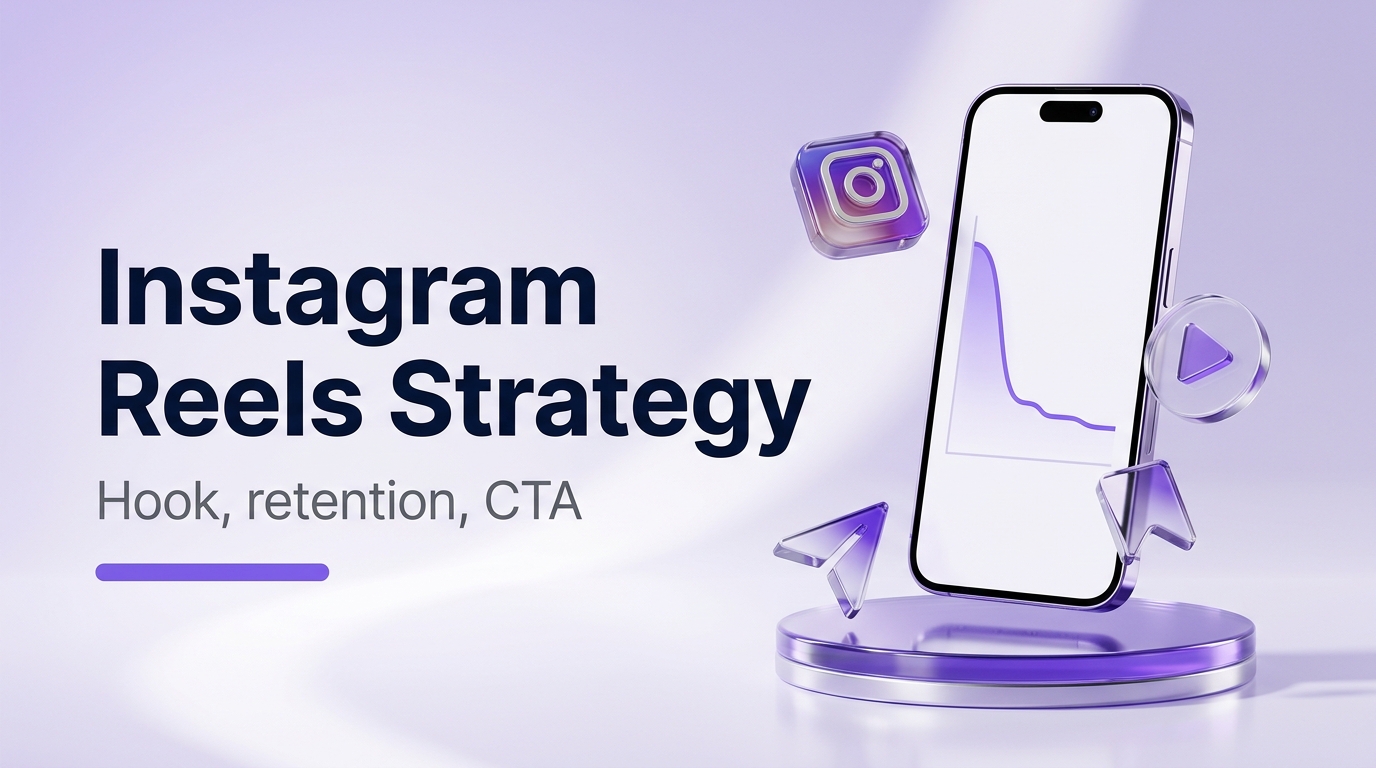
A working Reels strategy has three parts: a hook that earns the first three seconds, a structure that holds attention to the end, and a call to action that converts attention into a follow, save or DM. Reels fail at one of these three points, and diagnosing which one is the entire job.
Why do Reels succeed or fail?
Instagram distributes a Reel in stages. It shows it to a small group, measures the response, and either expands the audience or stops.
The signals that matter most, in rough order:
- Watch time and completion rate — did people stay?
- Rewatches — did they watch twice?
- Shares and sends — did they think of someone else?
- Saves — was it useful enough to keep?
- Comments — did it provoke a response?
Likes barely matter. This is why polished Reels with weak openings underperform rough Reels with strong ones.
Related: Instagram Algorithm Explained
How do you write a hook that stops the scroll?
You have roughly three seconds and no audio guarantee. The hook has to work as text on screen.
Six hook patterns that work:
| Pattern | Example |
|---|---|
| Problem callout | "Your Reels get views but no enquiries." |
| Mistake reveal | "Stop pricing your work like this." |
| Specific promise | "Three settings that fixed my reach in a week." |
| Contradiction | "Posting daily is hurting your account." |
| Curiosity gap | "Nobody tells small businesses this about GST." |
| Direct question | "Paying for ads before fixing this? Don't." |
Rules:
- Put the payoff first. Never open with a greeting.
- Show a face or movement in frame one.
- Text on screen from the first frame — a large share of viewers watch on mute.
- Be specific. "Three settings" beats "some tips."
- Cut the first two seconds of your draft. It is almost always throat-clearing.
Write the hook before the script. If you cannot write a hook for an idea, the idea is not ready.
How do you hold attention after the hook?
Retention is lost in the middle, not at the start. Four techniques:
1. Deliver value early, not at the end. Give the first useful point within five seconds. Withholding until the end is a habit from long-form video and it does not transfer.
2. Cut every pause. Remove breaths, filler words and dead frames. A one-second gap loses viewers.
3. Change the visual every 2–3 seconds. New angle, new B-roll, new text overlay. Movement resets attention.
4. Signpost. "Second one is the one people get wrong" tells the viewer why to stay.
Length guidance: make the Reel as long as the idea genuinely needs and no longer. A 15-second Reel watched fully outperforms a 60-second Reel abandoned at 20 seconds. If the idea needs 90 seconds and holds, use 90 seconds.
What makes a good call to action on a Reel?
One CTA per Reel. Two means neither happens.
Match the CTA to what the Reel earned:
- Taught something useful → "Save this for when you need it"
- Made someone think of a friend → "Send this to someone who needs it"
- Answered a question → "Comment your question and I'll answer it in a Reel"
- Showed a product → "DM 'PRICE' for the rate card"
- Showed a series → "Follow for part two"
For Indian SMBs, DM-based CTAs consistently outperform link-in-bio, because they keep the customer inside the app and start a conversation instead of a page load.
Place the CTA verbally near the end and as on-screen text throughout. Viewers who leave at 60% still see the text.
How do you structure a Reel from start to finish?
A reliable 30-second skeleton:
- 0–3s — Hook. Problem or promise, text on screen.
- 3–8s — Context. Why this matters to the viewer, one sentence.
- 8–22s — Payoff. Two or three specific points, one visual change each.
- 22–27s — Proof or example. A real number, a real customer, a real result.
- 27–30s — CTA. One ask.
Adjust the proportions, not the order. The proof segment is the one most people skip and the one that separates a Reel that gets watched from a Reel that gets a business enquiry.
What should Indian businesses post as Reels?
Five categories that work across most SMB niches:
- Answering a real customer question — you have dozens in your DMs already
- Correcting a category myth — high share rate, positions you as the expert
- Showing the process — kitchen, workshop, clinic, packing, quality checks
- Honest comparison — two options, real verdict, including when not to buy from you
- Before and after — the highest-converting format in visual categories
Language: match your customer, not your aspiration. Hinglish frequently outperforms formal English for consumer categories in India, and mixing languages within a Reel is normal rather than sloppy.
How do you diagnose a Reel that did not work?
Use the retention graph in Insights. Three patterns:
| Where viewers drop | What's broken | Fix |
|---|---|---|
| First 3 seconds | Hook | Rewrite the opening line; add text frame one |
| 20–40% mark | Structure | Cut the setup, deliver value earlier |
| Watched fully, no action | CTA or clarity | Add one specific ask; check the profile converts |
| Good reach, no followers | Positioning | Fix name field, bio and pinned posts |
Diagnose before you produce more. Publishing another twenty Reels with the same broken hook teaches you nothing.
How often should you post Reels?
Three to five per week is a realistic growth cadence for a small team. Below two per week, Instagram has too little to test.
Batch production makes this possible: one filming session per week producing four to six Reels, edited and scheduled in one sitting. Daily filming is the reason most businesses stop after a month.
Related: How Often Should You Post on Social Media (Per Platform)
Frequently asked questions
What is a good retention rate for a Reel? Compare against your own past Reels rather than a universal benchmark, since retention varies sharply by length and category. Rising completion rate on similar-length Reels is the signal that matters.
Does trending audio still help? It gives a small early boost, but only when the audio fits the content. Trending audio on an irrelevant Reel brings viewers who leave immediately, which hurts distribution more than the boost helps.
Should Reels have captions or subtitles? Yes, always. Many viewers watch on mute, and Indian audiences frequently watch in public settings. Subtitles are non-negotiable.
How long should an Instagram Reel be? As long as the idea needs. Short Reels are easier to complete, but a longer Reel that holds attention signals higher quality. Let completion rate decide, not a fixed target.
Can I repost the same Reel later? Yes. Re-record rather than re-upload the identical file, and space it several months apart. New followers have never seen it.
Batch a month of Reels in one sitting
Reels reward volume held over months, which is a production problem before it is a creative one. ZocialOne's reel script generator drafts hooks and scripts in Hindi, English or Hinglish, and the scheduler publishes them at your best-performing times.